
What a video analyst does from preparation to review
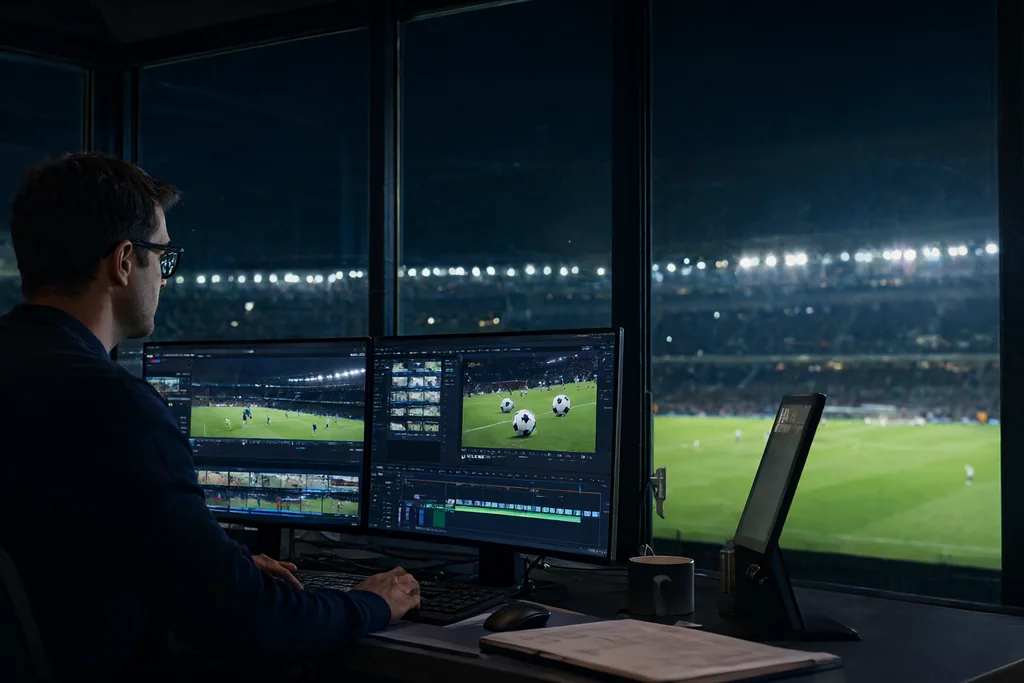
Video analysis looks passive from the outside: somebody in a dark room cutting clips. In practice the video analyst works to a deadline that starts days before kick-off and ends hours after the final whistle, and every stage has a fixed delivery time.
In this guide (8)
This guide follows the role through a match week — pre-match preparation, the clips built during the game, the half-time window, the post-match review and the report that ties them together.
The role before the cameras
A video analyst owns the footage: recording, logging, cutting and indexing. The job is to make sure that when a coach asks for a moment, it can be found in seconds rather than minutes.
That requires organisation more than creativity. A consistent naming system, a tagged timeline and a library that another analyst could navigate are worth more than an elegant edit nobody can search.
Pre-match preparation
Preparation usually means an opposition montage. The analyst selects the phases the staff care about — build-up, pressing triggers, set plays — and cuts short sequences that show the pattern rather than the outcome.
The discipline is in the length. A clip that runs for a minute teaches nothing, while a clip of eight seconds that shows the trigger and the reaction teaches the pattern. A montage is a teaching tool, not a highlight reel.
Timing matters too. The montage has to reach the players early enough to be watched more than once, which in practice means the day before the match rather than the morning of it.
Building clips during the game
Live clipping is a race against the next phase of play. The analyst tags events as they happen, marks the in and out points, and leaves the interpretation of context for later.
Most of the value comes from pre-built categories. If the staff agreed before kick-off that the review will cover rest defence, second balls and entries into the box, the analyst can tag into those buckets live instead of inventing a structure at full time.
| Clip type | Why it is cut | Who sees it |
|---|---|---|
| Opposition pattern | To show a repeated behaviour | Coaches before the match |
| Conceding sequence | To explain how a chance arrived | Coaches and defenders |
| Individual edit | To show one player's decisions | The player and their coach |
| Set-play review | To confirm routines and marking | Set-piece staff |
| Momentum block | To show a phase of control or collapse | Half-time and post-match |
The half-time window
Half-time gives the analyst a few minutes and a room full of people. There is no time to build a new structure, which is exactly why the categories must exist before kick-off.
The output is usually two or three clips with one sentence each. A coach who receives a clear point about the space behind the full-back can act on it; a coach who receives twelve clips will watch none of them.
The post-match review
The full review comes after the game and is built from the tagged timeline. The analyst selects the phases that decided the match, orders them by importance rather than chronology, and writes a short interpretation for each.
Good reviews separate what happened from why it happened. A clip shows the ball being lost in midfield; the interpretation says the passing lane to the pivot was closed because the wide player drifted inside. Only the second sentence is analysis.
Length is the other discipline. A review that runs to twenty clips will be watched once, at speed, while one that runs to six will be watched twice, and the second viewing is where the learning happens.
Report structure
Reports vary by club but tend to share a skeleton: a summary of the game's shape, three thematic sections with clips, and a short list of points for the next training session.
The order matters. If the summary buries the message, the reader stops before reaching the evidence. Put the conclusion at the top and let the clips support it, rather than building towards a point the coach has already guessed.
Tools and the limits of tooling
Software helps with capture, tagging and delivery, but it cannot decide what matters.
- Capture quality matters less than a consistent camera position.
- Tagging schemes should be agreed with the coaching staff, not invented alone.
- Automatic event detection still needs a human check on every clip used.
- Delivery speed decides whether a review is used at all.
- Shared storage beats personal folders that nobody else can find.
- A simple index everyone understands beats a complex one nobody uses.
Working with coaches who distrust video
Scepticism is usually about time, not evidence. A coach who has been handed a forty-clip pack before a match associates video with wasted hours, and no amount of production quality will change that association.
The remedy is small and predictable: one theme, a few clips, delivered when promised. Trust is built by being useful on a quiet weekday afternoon, not by the size of the library.
That is also why the role rewards patience. The analyst who delivers less, on time, every week ends up with more influence than the one who delivers everything late and expects gratitude.
Common questions
What does a video analyst do before a match?
The main output is an opposition montage. The analyst picks the phases the staff care about, such as build-up, pressing triggers or set plays, and cuts short sequences that show the pattern rather than the result. Clips stay short so the pattern is visible without a voiceover.
Why is half-time the hardest part of the job?
Because there is no time to build a new structure. The analyst has a few minutes to deliver two or three clips with one sentence each, which only works if the tagging categories were agreed before kick-off. Anything invented at half-time arrives too late to be used.
What goes into a post-match video review?
A summary of the game's shape, three thematic sections with supporting clips, and a short list of points for the next training session. The analyst orders themes by importance rather than chronology and writes an interpretation for each clip, separating what happened from why.
How do you build trust with a coach who ignores video?
Deliver less, on time. One theme and a few clips, ready when promised, teach a coach that video saves time rather than consuming it. A large pack delivered late confirms the opposite, and no amount of production quality repairs that impression.
Read next
Football data analyst: what the club job really involves
What a football data analyst does in a club: event and tracking data, the reports a coach will read, weekly support for staff and the matchday timeline.
Football analytics portfolio: what gets interviews
What a football analytics portfolio needs: one finished project, written conclusions, a small model that shows method and visuals that survive a second look.
Python or R for football analytics: what to learn first
Why football analysts write code, what Python and R are each good at, and the order to learn data handling, visualisation and modelling without wasting months.