
What a football data analyst does inside a club week
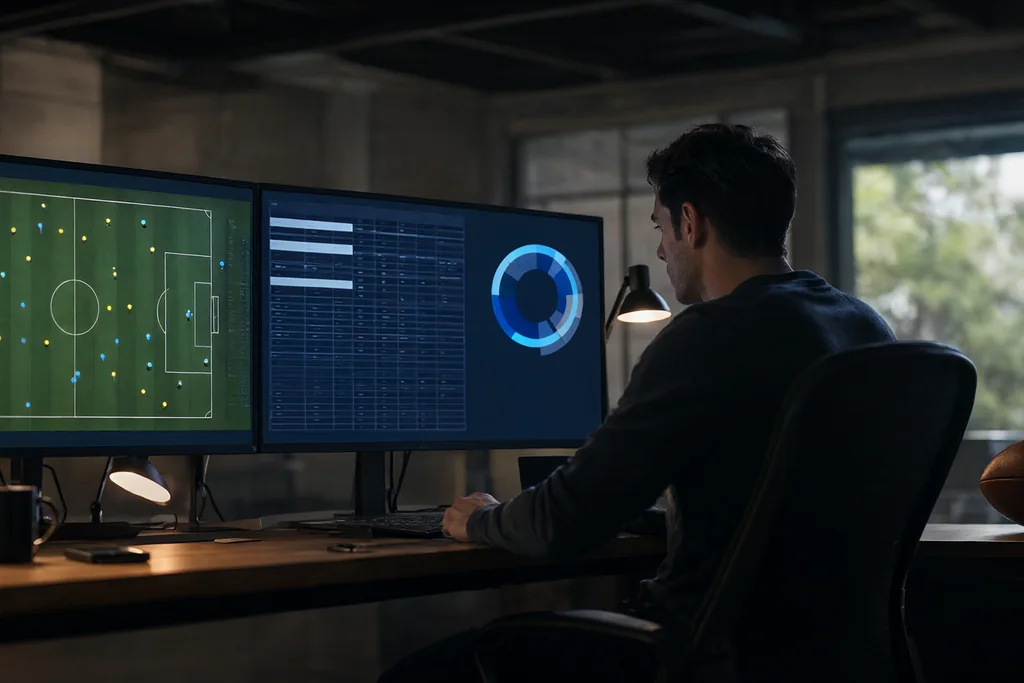
Every club that describes itself as data-driven needs somebody to do the work, and that somebody is usually a football data analyst. The job title covers a wide range of posts, but the core is consistent: turn event and tracking data into something a coach can use before the next training session.
In this guide (8)
This guide describes what the role involves week to week — the data an analyst handles, the reports they produce, how they support the coaching staff and what matchday actually looks like from the inside.
What the role actually is
A football data analyst is a translator. On one side sits a database of events, coordinates and model outputs. On the other sits a coaching staff with limited time and a specific problem, usually about the next opponent or the last performance.
The job is not to produce numbers. It is to decide which numbers answer the question, to check that they are measured consistently, and to say plainly what they do and do not show. Most of the skill lives in that last part.
The data an analyst works with
Event data records what happened — passes, carries, shots, duels — with a location, a timestamp and the players involved. It is the backbone of most club analysis because it is compact, easy to store and simple to aggregate into team and player summaries.
Tracking data adds the positions of every player and the ball several times a second. It answers questions event data cannot, such as how compact a block was or how far a defender travelled to close a passing lane, at the cost of far larger files and much more cleaning.
Around those two sit contextual sources: line-ups and formations, fixture and rest information, and the club's own notes from training. An analyst who ignores context produces numbers that are technically correct and tactically meaningless.
| Source | What it records | Typical use |
|---|---|---|
| Event data | Passes, shots and duels with coordinates | Team and player summaries |
| Tracking data | Positions of all players and the ball | Shape, distances, pressing |
| Line-up records | Who played where and for how long | Splitting samples correctly |
| Training notes | Load, availability and fitness context | Explaining unusual numbers |
| Model outputs | Expected goals and expected assists | Framing chance quality |
Reports the coach will read
Reports come in three rough sizes. The pre-match brief describes the opponent's habits. The post-match review explains what happened in the game just played. The periodic review steps back and looks at trends across a block of fixtures.
All three follow the same rule: a small number of themes, each supported by a couple of numbers and a clip. A report that lists everything is a report nobody finishes, and an unread report has no effect on the pitch.
Supporting the coaching staff during the week
During the week the analyst answers questions. Why did the press fail on the left? How often did the opposition play through the middle? Is the full-back receiving higher or lower than a month ago?
Good answers arrive quickly and in the language of the training pitch. The analyst who needs a day to build a dashboard has already lost the conversation, because the coach's question has moved on to the next fixture.
Matchday: the analyst's timeline
Matchday compresses the job. Before kick-off the analyst confirms the live feed is running, checks that the expected line-ups match the team sheet, and prepares a template so that half-time numbers can be filled in without delay.
During the game the work is monitoring rather than analysis: tracking the metrics the staff asked about, flagging anything unusual, and keeping notes on moments that will need a clip later.
After the whistle the real work begins. The review has to be ready early enough to matter, which usually means a short version for the staff that night and a fuller version the following morning.
Skills that matter more than tooling
Adverts emphasise software, but the people who last in the role tend to be strong in other areas.
- Knowing which question a metric can and cannot answer.
- Writing plainly, in short sentences, with the conclusion first.
- Cleaning data reproducibly, so a number can be rebuilt later.
- Watching football closely enough to notice when the data is wrong.
- Asking a coach what decision the analysis is meant to change.
- Saying that the sample is too small without being asked.
Where the role sits in a club
The reporting line shapes the work. Analysts inside the coaching department spend their time on the first team's immediate problems and produce fast, tactical output. Analysts in a recruitment or research function work on longer projects, wider player pools and models that must survive scrutiny from other analysts.
Both are legitimate paths, and moving between them is common. What changes is the horizon: days in one, months in the other, and with it the kind of evidence that counts as persuasive.
How the job differs from data science
A data scientist in football builds models; a data analyst uses them, interrogates them and explains them. The overlap is large, and smaller clubs often ask one person to do both, but the emphasis differs from the first week.
The analyst's output is a decision that somebody else makes with more confidence. Judged on that, a simple chart that changes a training session beats an elegant model nobody opens, and the role should be understood that way from the start.
Common questions
What does a football data analyst do day to day?
The role is mostly translation. An analyst takes event and tracking data, checks that it is measured consistently, and turns it into a small number of findings a coaching staff can use. Day to day that means answering questions from coaches, building short reports and preparing material for the next fixture.
Which data does a club analyst work with most?
Event data is the backbone, because it records passes, shots, duels and carries with coordinates, a timestamp and the players involved. Tracking data adds the positions of every player and the ball. Context such as line-ups, rest days and training notes is what stops the numbers from being tactically meaningless.
How does matchday change the analyst's work?
Matchday compresses everything into deadlines. Before kick-off the analyst checks the feed and the line-ups and prepares a template. During the game they monitor the metrics the staff asked about and note moments for clips. After the whistle a short review goes out quickly and a fuller one the next morning.
Do you need a data science degree for this job?
Not necessarily, but you need the equivalent skills in practice. Clubs care whether you can clean data reproducibly, choose the right metric for a question and explain the result to a coach. A portfolio that demonstrates those three things often matters more than the name of a qualification.
Read next
Football analytics portfolio: what gets interviews
What a football analytics portfolio needs: one finished project, written conclusions, a small model that shows method and visuals that survive a second look.
Video analyst in football: the real matchday workflow
How a football video analyst works through a match week: opposition montage, live clipping, the half-time window, the post-match review and the report.
Python or R for football analytics: what to learn first
Why football analysts write code, what Python and R are each good at, and the order to learn data handling, visualisation and modelling without wasting months.